



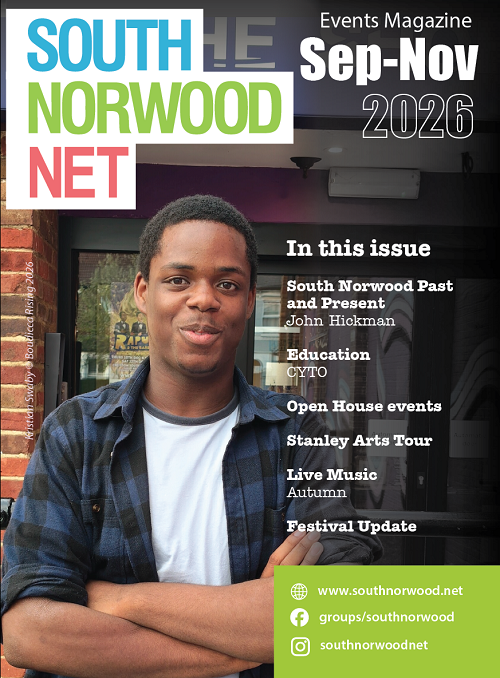
Our September to November printed edition focuses on South Norwood - Past and Future. October's online edition features a fascinating long form article from John Hickman about our high street.
5,000 printed copies of the magazine are placed in shops and through doors, as well as being available at local shops and businesses. Contact us if you'd like to have some at your business.
October 2026
An Edwardian postcard of South Norwood High Street about 1905
John I Hickman
This picture shows an Edwardian view of South Norwood High Street taken in 1905.
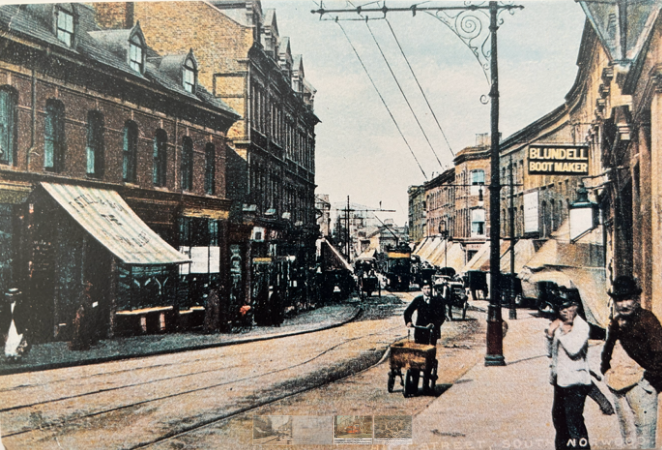
Had the Stanley commemorative clock then been at the junction of Station Road and High Street, South Norwood, the photographer would have had their back to it when taking this north-east view along South Norwood High Street during a sunny afternoon.
A feature of South Norwood High Street is that instead of the premises numbering being odd on the right and even on the left, here they are consecutive from No.1 at Oliver Grove to 47 at Goat House Bridge, and crossing over and returning, from No. 48 to end at No. No.91, which was the Alliance public house on the corner of Station Road. The shops at the tail end of Selhurst Road are traditionally included as part of the High Street.
Running from Selhurst Road to Goat House Bridge the street bisects the present A215, the road from Woodside, that is Portland Road on the right, and that going on to Upper Norwood, South Norwood Hill on the left. Although it can’t be seen in this view, this crossroad is at the centre ground of the picture.
The men on the right are standing outside The Alliance public house, on the corner of Station Road. To the right of centre walking in the road towards the photographer, a uniformed postman pushes an empty three-wheeled parcels cart on his way back to the sorting office in nearby Holmesdale Road. Over his left shoulder an open-top tram travelling towards Selhurst trundles its way between Grosvenor Road and Belgrave Road.
On the left the outstretched sunblind shading the window of No.4 has F. Still’s name printed on it. Still was a prize-winning cow keeper and dairyman1 with a retail outlet supervised by a manager acting as agent at No.4 High Street.2 Fifty cows from the dairy herd were milked each day3 from which Still stocked his shops and delivered to homes. Towards the end of the 19th century Still had farms located at Harrington Road and Whitehorse Farm Dairy, Clifton Road4 which were closer to the South Norwood district centre. Both grazing locations were lost to housing as the suburb grew. During the early years of the 20th century the business was stocked with produce from the family farm then at Shirley Park, Woodside.5 ibid March 19th, 1904. 1b. A herd of Alderney cows was maintained at Shirley to provide milk especially recommended for infants and the invalids.6
At the time this photograph was taken Still’s business was certainly in the ascendant. In 1904 he had won prizes at the Croydon Stock Show, not only for the classes of breed; Shorthorn bull, Shorthorn cow and Alderney cow,7 but additionally for the high quality of their milk.8
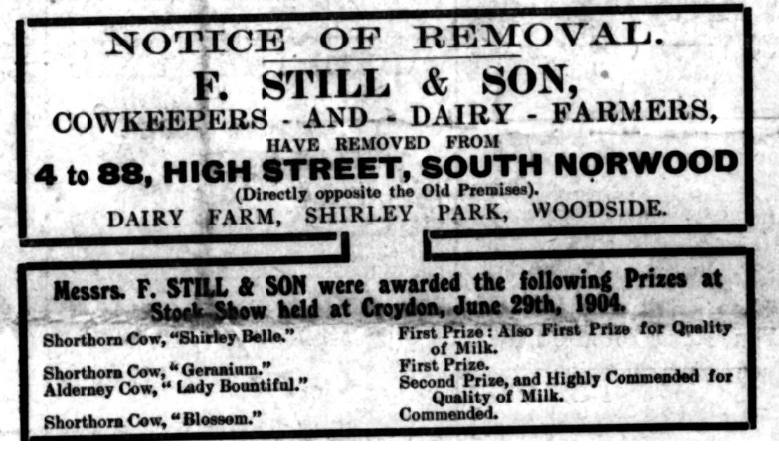
In April 1907 Still placed an announcement in Norwood News, (see notice left)9 a local newspaper, saying he was removing his sales business from No.88 to the opposite side of the road, to the unoccupied No.4 High Street; the premises vacated by John Blundell in late 1904. (see below). This calls into question the dating of the image at 1906.
Still’s business was unwittingly caught up in controversy in March 1918 when they were summonsed to appear before Croydon Police Court10 for selling, through their agent, milk containing 22% added water. That Still knew nothing of the behaviour of their agent was accepted by the court, but ignorance did not relieve the business of all liability. They had to pay costs while their late agent, who was suspected of another irregularity at the time – that of leaving a gallon milk can just outside the yard for another carrier, his son.
The man employed by Still as his agent was heavily fined with the alternative of being sent to prison for a month. The £10 fine, the analyst’s fee of 10s 6d (521/2 p) and solicitor’s fee £1. 1s. (£1. 5p.) was paid11 without procrastination.
Still’s Dairy continued retailing at No.4 High Street until ‘Welford’s Surrey Dairy’ took over the premises in 1921.12
The right side of the picture shows many of the shops with their blinds drawn down to protect goods in the window from the bleaching effect of over exposure to sunlight. Now rarely seen, some readers may recollect sun blinds; where each blind had a bar at the end of either side extending from the outermost edge fixing it to the shopfront. To some, particularly tall, unwary men the awnings were a nuisance because, like the overhanging low branches of trees in front gardens, the bar would damage their silk hats, sometimes knocking them from their owner’s heads. Shopfront window-lamps also contributed towards this perennial problem. A letter published in Norwood News13 complained about the cost of having to have a hat repaired or replaced because of the damage caused by these nuisances. Additionally, children, particularly young boys, were a cause of irritation to High Street retailers because they would jump up, catch hold of the sun blind bar and swing on it until the shopkeeper or some other sensible adult chastised them.14
Taken at the beginning of the 20th century, the photograph shows street lighting to be sparse with lamps attached to the tram line electricity cable carrying standards. Exterior shop window-lamps were part of the townscape, allowing potential customers to window-gaze displays after dusk and they likely provided a welcome source of light for the pedestrian on dodgy pavements. One such lamp can be seen beneath John Blundell’s prominently displayed signboard on the right of the image (another is present in the top right corner).
The Blundell to whom the signboard refers was Bow-born John Blundell, a man then in his 60s,15 whose bootmaking business occupied 88 High Street.16 Blundell had moved to No.88 from No.79 during early 1890.17 Meanwhile Upson & Co., advertising themselves as ‘The Great Boot Providers’18 immediately opened a branch at No.79 in mid-March.19 Upson’s placed a large advertisement above the shop fascia on the front elevation of No.79. In the image above, this appears as the off-white trapezium immediately below the left corner of John Blundell’s sign. Blundell meanwhile had left No.88 by late 190520 and the premises remained unoccupied until 1907.
The divided back of postcards (the left side for a message and the address on the right) was introduced in 1902.21 The original postcard has a divided back and is therefore of 1902 or later. Coupling this with the presence of Blundell’s shop sign in the location shown indicates the photograph was taken between 1902 and the late autumn of 1904. As mentioned above, the premises were unoccupied in 1906. It is possible, but highly unlikely that John Blundell left his signboard on the front elevation of No.88 after he had left the premises.
Returning to the left side of the picture, Still’s neighbour at No.5 High Street was jeweller and watchmaker Henry Burgess.22 Burgess was among the few who had been in business in the High Street for a long time, certainly as far back as 1871.23 Although Ward’s Croydon Directory continues to show Burgess’s name at the premises until 190424, by 1901 the property was occupied by South Norwood born Edgar George Cundy25 and his family. In late February 1897 a judgement at Croydon County Court found in favour of the plaintiff (claimant) ‘Edgar George Cundy (Burgess & Co.)’ against Edwin Bousfield for non-payment for goods.26 It is feasible that Cundy traded under the business name of Henry Burgess at 5 High Street. Originally Cundy had established himself as an oculist and optician27 but evidently by 1901 was a watchmaker and jewellery tradesman.28
In the spring of 1900 had Edgar G. remained with his earlier trade he may have seen where he and his wife were riding their bicycles thereby keeping them out of trouble. Both were summoned by the police for riding their bicycles on the footpath along Spring Lane, Woodside.29 Edgar offered the excuse that the roads were bad and muddy.30 The court wasn’t having any of it and Edgar and his wife had to pay 5s 6d (271/2 p) each in costs31 after apparently being bound over.
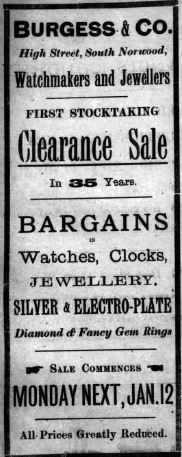
Edgar G. Cundy appeared as a witness in a court case in 1903 for a woman he employed as a manager.32 She was the victim of domestic difficulties and her husband had threatened to smash her employer’s windows. This resulted in Edgar Cundy requesting the woman to leave his employment. While giving testimony Cundy said that he had two shops in South Norwood High Street.33 A search reveals that one was a goldsmith and jewellery business at No.12,34 while the other was probably the jewellers at No.5. Whatever the business arrangement was at 5 High Street, in early 1903 a clearance sale, the first in 35 years, was advertised by Burgess & Co.35, offering attractive reductions on watches, clocks and jewellery36. In the event, Cundy continued his arrangement with Burgess at 5 High Street until R. S. & A. P. Cufflin took the premises in 1904.37 They continued to trade in jewellery, clocks and watches.
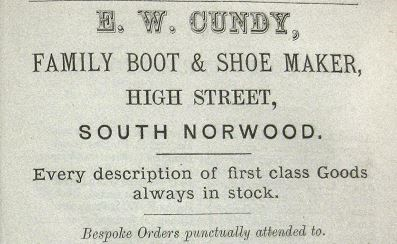
Wilkins Croydon Directory 1865-1866. 167.
Edgar George Cundy, the clockmaker, was the son of Edgar William and Frances Cundy a bootmaker employing eight men and a boy in a thriving business next door at No. 6 High Street.8 Edgar W. Cundy married Frances Philpot at St. Leonards, Sussex in 186539 and they arrived at South Norwood shortly afterwards. The Cundy family had been making, repairing and selling boots in the High Street certainly since 1865.40 Frances was the manager of the business at 6, High Street from 1889,41 until 189742 when her husband took over the responsibility.
Edgar W. Cundy must have had a profitable bootmaking business because by 1901 he was the owner of a motorcar. At the time, motorcars were very expensive being available only to those of some wealth. It was as an automobilist that in late October 1901 Cundy was summoned by the police for furious driving along Brighton Road.43 The police constable who witnessed the incident testified that the defendant’s motorcar went by like a flash of lightning and covered 150 yards in two seconds.44 This works out to be 153 miles an hour, whereas the defendant swore he was driving at about eight miles an hour and two witnesses could corroborate this. The case was dismissed.45
Despite succumbing to his passion for speed, Edgar and Frances Cundy were both well-respected and active members of local trade and social circles.
The dominant building just left of centre of the photograph is Nos.7 to 10 High Street. Likely designed as the centrepiece of South Norwood High Street, it was constructed as a grand parade of five shops. When the photograph was taken No.7 was occupied by Frederick Grant, a draper46; while at 7a and 8, J. Reeve had a hosiery and clothing business.47 Another bootmaker, Rabbitt & Son had their business at No.9,48 and at 10 on the corner of St. John’s Road (then St. Dunstan’s Road) was F. Stephens the ironmonger.49
Shoehorned into the narrow gap between Cundy’s bootmaking premises and Grant’s drapery at No.6A was Johnson Bros. dyers and cleaners.50 Having moved there during 189951 they continued with the same business until leaving at the end of the First World War.52
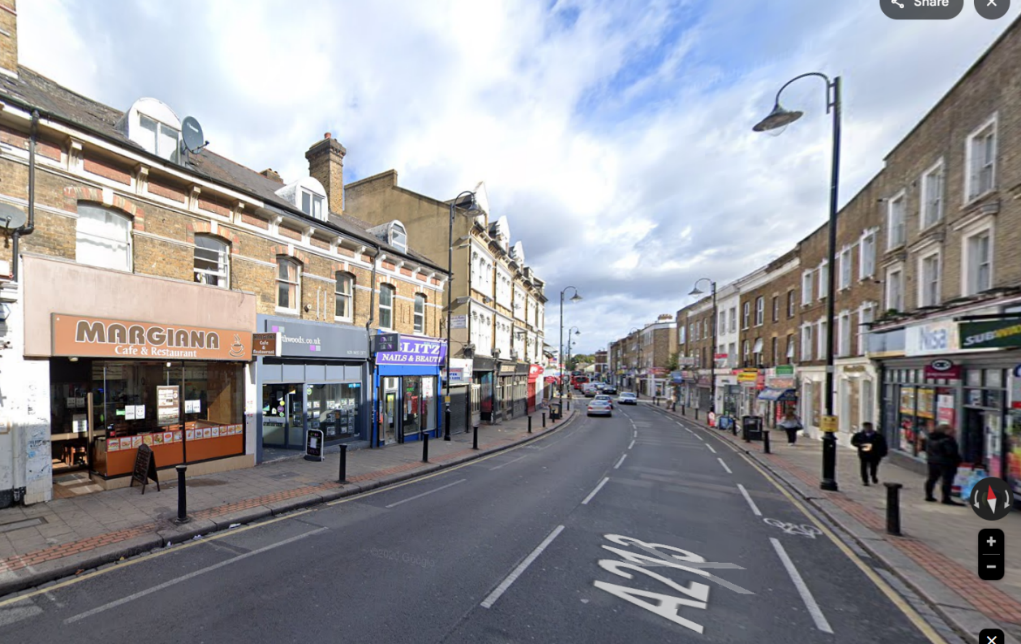
Were anyone to stand on the same spot today as the photographer did at the beginning of the 20th century the built landscape would be seen unaltered except for the modern shopfronts. All the buildings remain but house businesses that reflect the changing nature of the High Street during the final years of the 20th and early 21st centuries. For the final years of the 20th century No. 4 was a Wimpy Bar; a café and restaurant presently occupy the premises. Next door, at 5 High Street is an estate agent, while at No.6 is a nails manicurist and beauty establishment, while 6A, continuing to look squeezed, is an off-licence.
The tramlines are long gone, replaced by the lamp standards with their great globular bulb’s characteristic of the Croydon Conservation Areas. Once ubiquitous, sun blinds are now scarce, but there again, so are men wearing hats.
(For my own edification I tried to get the similar view in 2020)
EVENTS
South Norwood events can be viewed here.
COMMUNITY GROUPS
Local community groups and associations can be viewed here.
BUSINESS DIRECTORY
The local business direcory can be viewed here.
FOR BUSINESSES
Currently, we offer free directory space for businesses and traders based in South Norwood here: www.southnorwood.net/business-directory.html.
We also tweet short, free adverts for businesses on X here: www.x.com/SouthNorwoodNet.
We publicise events for free here: www.facebook.com/southnorwoodnet and also have a fortnightly events email that goes out to just over 1,000 people.
We have advertising space in the magazine which will cost £75 + VAT per quarter page full colour advert.
We will consider discounts for businesses who advertise in more than one issue and also for community groups. You can contact us at
Please note that we would need any associated copy for advertisements with us by no later than 31 October 2026 for the December 2026 - February 2027 edition. Thanks!